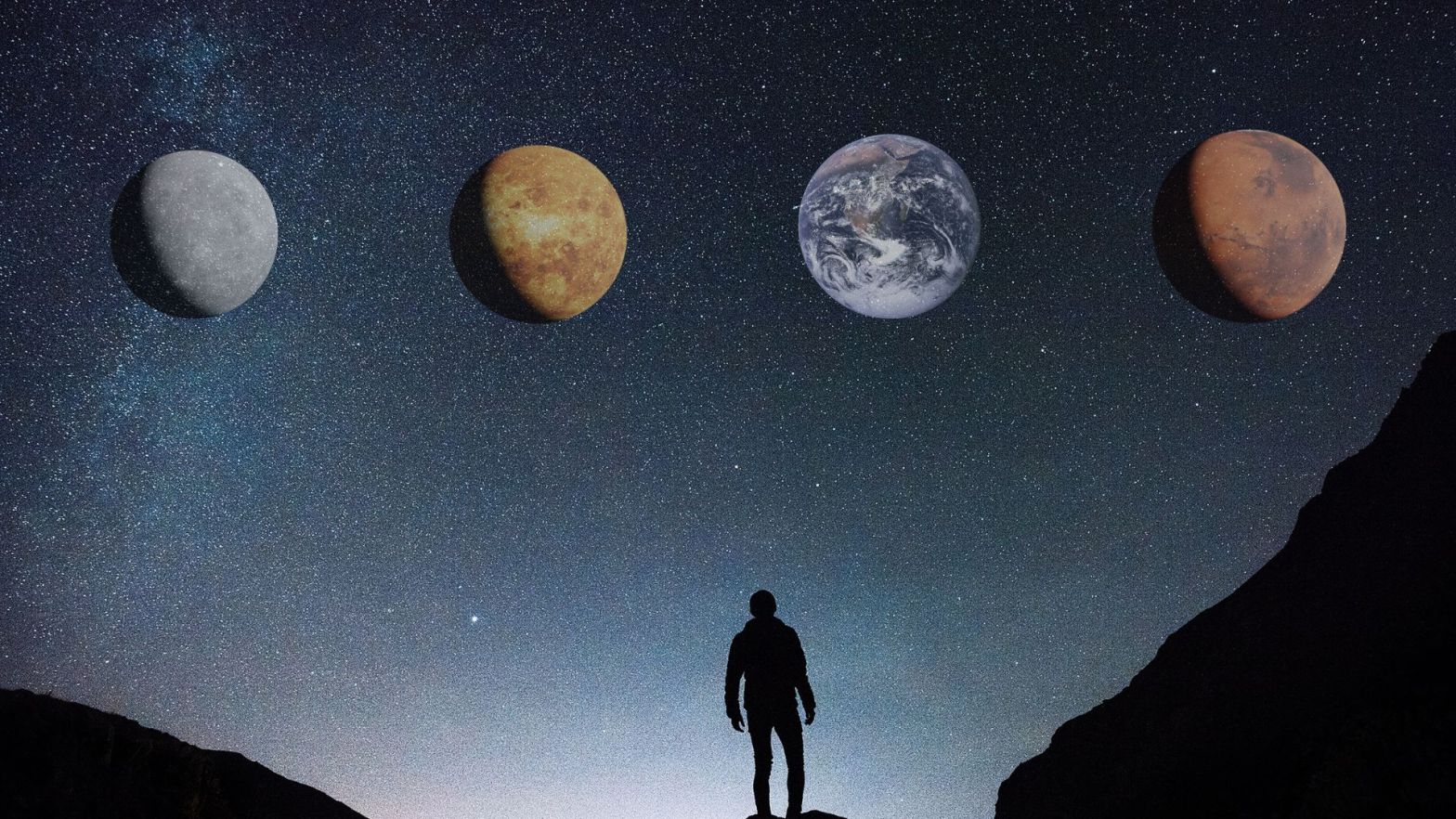
It’s time to create outline views of the planets in the fictional future solar system. After thousands of years of manned space flight, complete with significant ups and downs, it is quite diverse.
I’ll avoid mentioning space stations, captured comets, navigable asteroids and anything else that is permanently part of the inner system but not a planet.
So that just leaves us the four big places. Mercury, Venus, Earth and Mars.
Mercury
The closest world to the Sun. Mercury is small, hot and, from a distance, bright. It’s a challenging place to colonise, but people have made it home. However, it does orbit the Sun in only 88 days. Coupled with very low gravity and an almost non-existent atmosphere, Mercury was an interesting place from a launching outward point of view.
Records suggest that the early colonisation of Mercury was all about science and mineral exploitation, but over time, that changed. The vast temperature range of Mercury’s surface (-180C to +450C) had always made being on Mercury challenging. Even with superlight construction from nanoengineering. People went deeper into the planet, and they became more insular. A culture based on sending small light sailed craft outward to trade ideas, science and pop culture grew and combined with the concept of we don’t want anyone else here. Today you may listen to Mercury Rock but have almost no chance of getting an official permit to visit.
Of course, plenty of people are also offering maps to Mercury’s lost old mines. Those are probably best avoided.
Venus
Venus was and still is the hottest planet in the solar system, with a crushing atmosphere and clouds of sulphuric acid. The age of super strong nanomaterials made the exploration of Venus possible, but life on the ground was never a great idea. Life in the clouds, though, was something else. Orbital research structures gave way to vast dirigibles. Filled not with helium or hydrogen but with a pure vacuum. Made from advanced materials that could handle the pressure difference between outside and inside the balloons. However, these never went near the surface. Instead, floating tens of kilometres up in the air where the pressure outside was near that of Earth.
Over time these turned into vast cities. Always taking the form of massive balloon shapes, with habitat areas not slung underneath but blistering out from the surface.
Venus is one of three planets in the solar System to have life that goes beyond human colonisation. It started natively with processes creating the markers for life. At some point that was enhanced and species to live in the clouds were evolved. It made living in what were effectively floating spaceships easier, that ability to look outside and see something flying by.
Venus even at altitude is not a planet with native water. Most life depends on reservoirs built for human cities. Water is rare and valuable making the flying life of Venus voracious hunters of water. Beware of the water hunters of Venus.
Earth
The world of a thousand nations, and that’s just on the ground. Take into account orbital and subsea nations, and the list gets much longer. Just about every type of government can be found in, on and around the Earth. In terms of size some of these countries are little more than city states and others go on for as long as the eye can see. Earth is the home of humanity and the most diverse place in the solar system.
Making sense of what would otherwise be chaos is the Common Trade and Defence Authority. The history of which goes back more than 2000 years, emerging as a force for cohesion sometime during one of the dark ages. Known to the people of Earth as simply the Authority or to those else where as the Commonality it provides a singular point of reference for all trade with the people of Earth. It also runs the biggest army and one of hte largest fleets of warships. Don’t think of the Common Trade and Defence Authority as a government. It exists as a framework for cooperation and united action. Major decisions are taken by the Council. Nine elected representatives each put in place by elections held on the ground. The nine are not Prime Ministers or Presidents. Think instead of judges who will rule and debate based on law before voting on a final decision.
Mars
When it was time to spread to the other planets, Mars was the first to be colonised. By the simple virtue that it was the easiest to survive on. It became the target for just about every scheme and strategy for living on an inhospitable to be tried. There are domed cities, underground cities, areas of limited terraforming and little Earths. Its all there.
Also there are monsters. Trying to create organisms and engineered people that could survive not under native Martian conditions but under the conditions where engineering created more survivable zones had variable results. Some of these became true native dwellers and some of these are truly terrifying.
Mars is a diverse and complex place. Lots of different ways of living. Lots of different relationships with the rest of the Solar System and of course people and animals that are truly strange and Martian.
Mars might just be the strangest place in the Solar System.
To Finish Off
The Solar System of Solar Stories is a very complex place. It’s probably impossible to describe everything in a digestible number of words. This is part of the answer to that problem. A framework that, whilst general, gives a starting point for individual customisation. It’s a macro view of things at a set point in time. Other histories and detailed descriptions and be written for unique locations and timelines. But this is the overview to work from. At least for the planets of the inner solar system.
 Stream of Consciousness