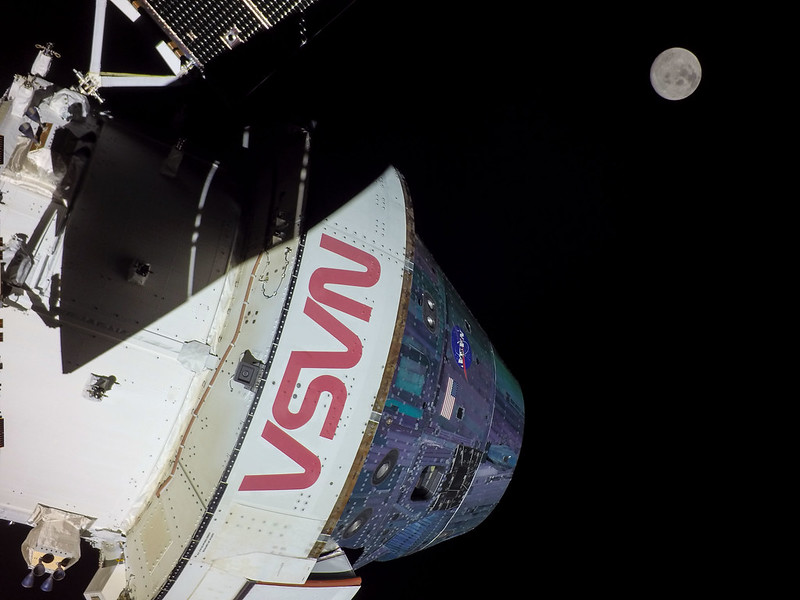
On the 16th of November, 2022, Artemis 1 lifted off from Kennedy Space Centre. It was a night launch for the most powerful rocket yet to fly, making it spectacular. It marks the first launch of a programme that will put people back on the moon. It’s almost exactly 50 years since the last manned moon mission (the last lift-off from the moon was on the 19th of December, 1972). Artemis 1 is not manned – unless you count some lucky plushies. It is the start of what is hoped to be a long-lasting period of lunar exploration.
Artemis
The aim of Artemis is to continue the exploration of the moon. Don’t think of this as a purely American endeavour; it is NASA working with other space agencies and commercial endeavours. Let’s understand what is going on by breaking things down a bit.
Space Launch System (SLS)
The big rocket. The world’s biggest rocket. The job of SLS is to get heavy loads into Space and onwards to the moon. It’s the key to flying the Orion spacecraft.
Orion
Orion is a spacecraft designed for deep space. Its purpose is to carry a crew to the moon and possibly a lot further. In addition to a human crew, the SLS can also carry and launch cubesats. Orion is a ship of two parts. Astronauts live in the Crew Module. There is also a European Service Module built by the ESA. The service module provides key services such as power and thrust to the Orion spacecraft.
Cubesats
Artemis missions are designed to deploy small satellites from the Orion spacecraft adaptor ring sitting between the Orion Spacecraft and the SLS. As part of Artemis 1, 10 cubesats were deployed. These are part of the Cubesat launch initiative. Cubesats are built from off-the-shelf parts by universities, schools and non-profit organisations.
Gateway
Set to orbit the moon, Gateway is a small space station destined to work as a laboratory and a place for astronauts to prepare for trips to the lunar surface. Gateway is another collaboration with components from the Japanese Space Agency, Canadian Space Agency and European Space Agency.
Human Landing System (HLS)
Travelling to the moon would be a little pointless without landing on it. The purpose of the Human Landing System is to accomplish just this. The vehicle set to accomplish this is a variation of the SpaceX starship. Starship is in development to be a flexible and reusable space transport system. Many different Starship models are planned, one of which will land men on the moon.
More Cooperation than National Pride
The first manned attempts to land on and explore the moon were all about proof of superiority. That one nation could do something technically incredible. This new mission may be led by a national agency, but it has many partners. We are now looking at a large-scale international effort. Perhaps this is the promise of the 21st century. Not my country or belief is better than yours. Instead, a statement that together, we can do amazing things.
I hope so – the challenges of this century are truly global.
This Series
This overview of Artemis was written as the first mission flew. As I publish, Artemis 1 has splashed down. No doubt there will be things to learn and more related information in the future.
 Stream of Consciousness